

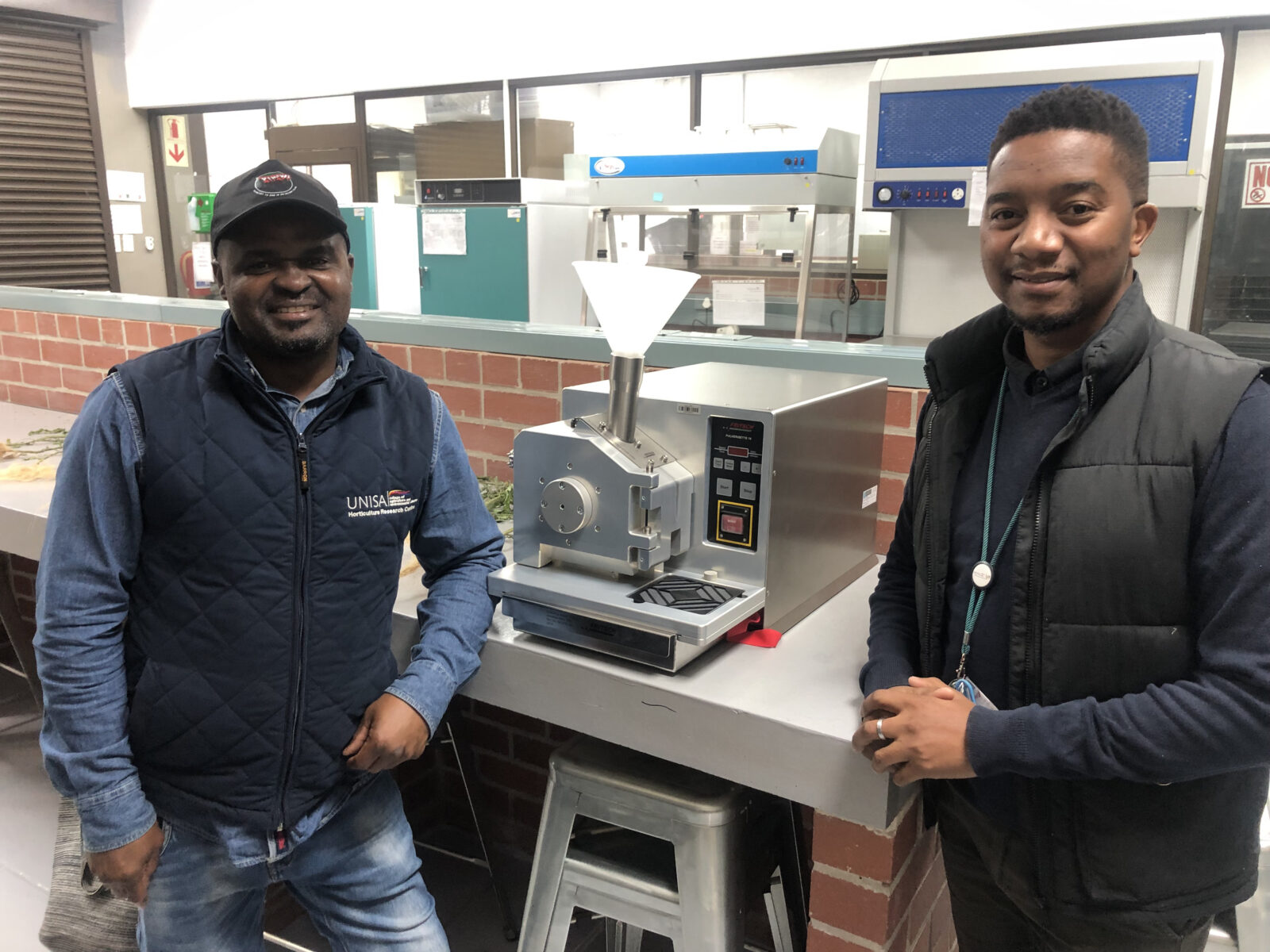
To streamline workflows and support upcoming ISO accreditation, the Collage of Agricultural and Environmental Sciences at UNISA’s Florida campus has upgraded its former potting shed into a functional laboratory. As part of the upgrade, the lab acquired the robust Fritsch Pulverisette 19 Universal Cutting Mill, designed for grinding tough plant materials like bark into fine powder with greater precision. The new equipment, paired with a range of sieve sizes, allows them to grind material in stages—starting coarse and working down to a fine dust—ensuring durability and consistency.
The image above features Mr. Beetroot Maimela, a lab technician, alongside Dr. Garland More, both of whom are shown with the Fritsch Pulverisette.
Dr Garland More, Chief Laboratory Technologist and specialist in medicinal plant research, uses these finely ground samples to extract compounds for studies in antibiotics and other therapeutic applications. “We extract compounds from plant powders using solvents like ethanol, hexane, or methanol, depending on the research,” he explains.
Current research includes anti-cancer and studies using Hypoxis hemerocallidea (African potato) and Artemisia afra (African wormwood), which have
shown strong antiviral and anti-diabetic properties when synthesized into nanoparticles. “Some medicines can’t easily enter the body,” says Dr More. “Nanoparticles act as vehicles, carrying compounds into cells and the bloodstream, where they begin to work. We’re doing similar work with Moringa.” The research on medical plant metabolomics at UNISA’s Collage of Agricultural and Environmental Sciences, has already positioning it as a hub for groundbreaking plant based medicinal research.
