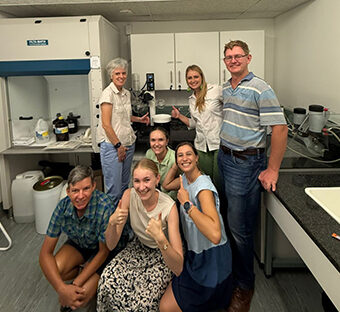
The lucky recipient of the BÜCHI R-80 Rotavapor® System is Prof. Wilna Liebenberg from the Pharmaceutical Sciences department at North-West University (NWU). Prof. Liebenberg entered the competition at Analytica LabAfrica, held in Johannesburg last year, and emerged as the winner!
The R-80 Rotavapor® has now found its new home in the department’s laboratories, where it occupies minimal bench space while delivering maximum performance.
Supporting Pharmaceutical Innovation at NWU
The Pharmaceutical Sciences department focuses on pharmaceutical solid-state chemistry and drug delivery research. The R-80 Rotavapor® System plays a vital role in multiple stages of their work, including:
- Evaporation of residual solvents following the synthesis or extraction of active pharmaceutical compounds
- Drying products to powder form for further processing and formulation development
Its compact footprint and reliable performance make it an ideal fit for their dynamic research environment.
The Competition
During last year Labotec hosted a competition as part of its live workshops and demonstrations to showcase the BÜCHI R-80 Rotary Evaporator — the most compact Rotavapor® currently available on the market. One of which was the Analytica LabAfrica exhibition, where the lucky winner came from.
The R-80 represents one of the most energy-efficient Rotavapor® systems in its class. Designed as an entry-level instrument, it delivers trusted BÜCHI quality at an affordable price point while ensuring efficient use of valuable laboratory space. It also supports more environmentally conscious evaporation processes through improved energy efficiency.
A Rotavapor® for Every Laboratory
The R-80 forms part of BÜCHI’s powerful and versatile Rotavapor® portfolio:
Compact, efficient, and ideal for space-conscious labs.
Robust performance with intuitive operation, enhanced safety features, and support for evaporating flask sizes up to 3 L — a smart addition to any laboratory seeking greater capacity.
The premium solution, supporting flask sizes from 50–5000 mL. The R-300 can be upgraded to a fully integrated automated system with a central interface that controls each component and offers an extended temperature range of 20–220 °C.