

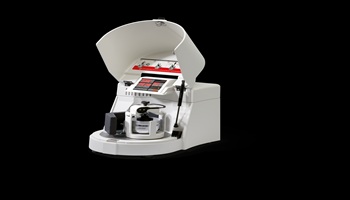
Fritsch planetary ball mills convert kinetic impact and frictional energy directly into chemical activation, running rapid organic coupling reactions like Suzuki, Sonogashira, and click couplings in minutes. Completely solvent-free!
Open any synthesis lab’s waste log and you can see where the cost sits. It isn’t in the reagents. It’s in the solvents: buying them, heating them, extracting with them, and disposing of them. What if a good share of that disappeared, and the reaction finished in minutes?
That is the promise of mechanochemistry, and the tool behind it is one many labs already know as a grinder.
From grinding to reacting
Mechanochemistry studies how mechanical energy changes solids chemically. As Fritsch’s Global Laboratory Manager, Leos Benes, explains in the company’s overview report, it traces back to a simple mortar and pestle, used more than a century ago to pull a metal halide apart into metal and halogen.
The logic is straightforward. When a mill breaks particles down, surface area rises sharply, and so does the number of surface defects, which act as reactive sites. Keep milling and solids start reacting with each other directly. This is called reactive milling.
A planetary ball mill is built to drive that process hard. Grinding bowls spin on a sun disc that rotates the opposite way, which sends the grinding balls on complex paths. The result is a constant mix of friction and high-energy impact. That kinetic energy ends up as heat and activates the reaction, with no solvent carrying it.
Real reactions, real numbers
Researchers at the Institute for Technical Chemistry and Environmental Chemistry at the University of Jena (Achim Stolle, Bernd Ondruschka and colleagues), working with Fritsch, have shown that this goes well beyond materials science. Reactions that used to need a flask, a solvent, and a heating mantle now run in the grinding bowl:
- Suzuki cross-coupling: Aryl bromides and phenylboronic acid, catalysed by plain palladium acetate on a solid base, gave biphenyls in 10 minutes with yields of 18 to 98% depending on the substrate.
- Sonogashira coupling: Aryl iodides and terminal alkynes reacted in 20 minutes, with yields of 47 to 95%. Selectivity for the cross-coupled product stayed above 95%, even in air. Homo-coupling, the usual side reaction, was either absent or below the detection limit.
- Copper-catalysed azide-alkyne “click” reactions: Azides are shock-sensitive, so the team mixed quartz sand into the charge to cushion it. In 10 minutes the reaction gave triazoles in 80 to 98% yield.
The click chemistry was also applied to a polymer carrying a terminal alkyne, and the polymer chain stayed intact. That has opened the door to attempts at polymerisation in the mill.
What the energy numbers say
The most striking result is the energy comparison. For the oxidative coupling of p-toluidine to an azo dye with , the Jena group compared five ways of putting energy into the same reaction:
| Reaction Method | Solvent System | Yield (%) | Energy Intensity (kWh/mol) |
| Planetary ball mill | Solvent-free | 97% | 18 |
| Mixer ball mill | Solvent-free | 94% | 5 |
| Ultrasound | Water/acetonitrile | 94% | 24 |
| Heating bath | Water/acetonitrile | 86% | 37 |
| Microwave | Water/acetonitrile | 85% | 118 |
Ball milling as a technique comes out well ahead. The planetary mill gave the best yield of any method and used about half the energy of the heating bath and roughly a sixth of the microwave route, all without solvent. The mixer mill was leaner still on energy, at a slightly lower yield. The authors also found that larger planetary mills turn their power input into useful kinetic energy more efficiently, which matters when you plan to scale up.
It’s not magic, it’s parameters
The Jena work is clear about one thing: results depend on set-up. The type of mill mattered less than you might expect. What mattered most was:
- Milling material: Sets the energy transferred through its density, and it has to survive the chemistry.
- Number and size of balls: For synthesis, ball size mattered less than keeping the total ball mass constant.
- Filling degree: Too little feed wears the media down, and too much stops the balls from moving.
- Frequency and time: Control wear energy and reaction progress.
That is good news for method development. These are controllable variables, not black-box effects. In one example, oxidative cleavage of beta-pinene to nopinone, the mill proved to be a genuine alternative to low-temperature ozonation.
Beyond synthesis
The same machine does other jobs in the same lab. Fritsch’s mechanochemistry report points to:
- Mechanical alloying: Particle surfaces are coated with another material.
- Nano-scale powders: Particle properties differ from those of the bulk material.
- Pharmaceutical polymorphs: Mechanochemistry converts actives into more useful crystal forms.
- Hydrogen storage materials: Mechanical modification improves capacity and absorption kinetics.
One instrument can therefore serve the synthesis chemist, the materials group, and the formulation lab.
Honest about the limits
Temperature control inside a milling bowl is still an open problem, and results differ from reaction to reaction, so each one needs its own optimisation. The researchers say so themselves. The upside is that reaction times of minutes, low energy use, and no solvent make a compelling case for trying.
Choosing the right mill
Fritsch’s planetary range covers a wide span of needs:
- PULVERISETTE 5 and 7 premium line: Reaches a final fineness below 100 nm in about 3 minutes, with automatic bowl clamping and imbalance control. The PULVERISETTE 7 is the mill shown in the Jena report.
- PULVERISETTE 7 classic line: Two working stations, made for very small samples ground to colloidal fineness, dry or in suspension, and also used to mix and homogenise emulsions and pastes.
- PULVERISETTE 6 classic line: A single-bowl mill with simple imbalance compensation and speeds up to 650 rpm, well suited to mechanical alloying and homogenising.
- PULVERISETTE 5 classic line (two or four stations): Handles 0.5 to 900 mL of sample, feed sizes up to 10 mm and speeds up to 800 rpm, grinding to below 1 micron.
Cut reaction times from hours to minutes. Contact Labotec to discuss your lab’s specific application requirements and request a demonstration.
